-
Address: 16/9, Scotland United Kingdom
-
Email: fodgesol@example.com
-
Phone: +1 16355 65389
-
Address: 16/9, Scotland United Kingdom
-
Email: fodgesol@example.com
-
Phone: +1 16355 65389

Blog
Why AI-Enhanced CDI
is the Future of Clinical Performance
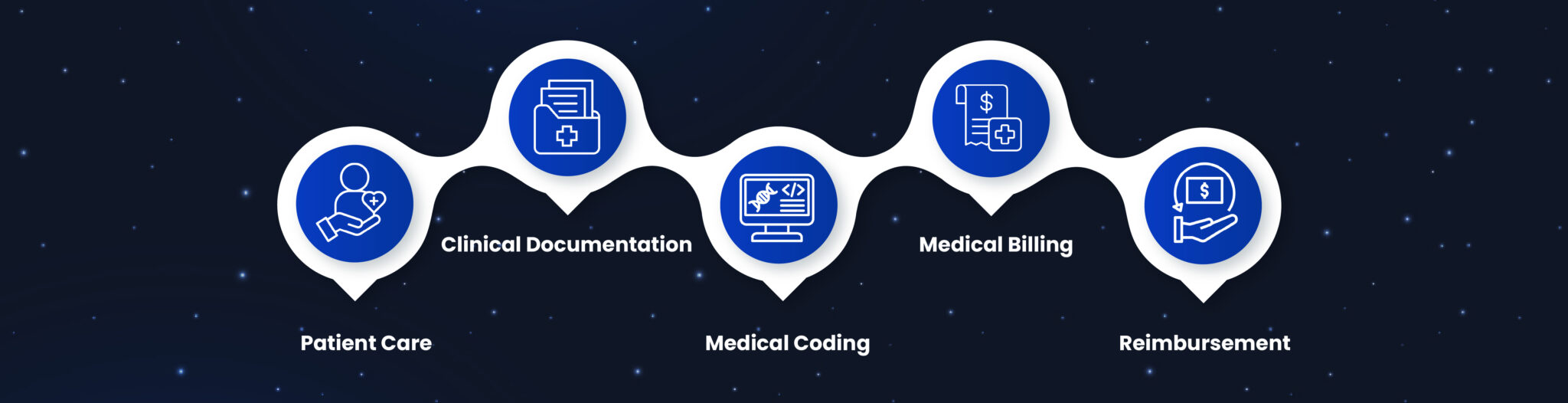
Clinical documentation is the backbone of revenue, compliance, and patient care. Every financial and clinical outcome in a hospital traces back to how well the encounter is documented. The entire healthcare revenue process can be visualized as a sequentially connected system:
If documentation (the second step) is weak or incomplete, the financial and quality outcomes of the entire system are at risk.
Clinical Documentation Improvement (CDI) strengthens that system and AI now accelerates it.
The Critical Role of CDI in Healthcare Systems
Ensuring Accurate Code Assignment and Reimbursement
One of the most direct and measurable impacts of CDI is accurate reimbursement.
Payers reimburse based on Diagnosis-Related Groups (DRGs), complications, comorbidities (CCs) and the severity of illness. CDI specialists identify missing CCs/MCCs that can change a DRG assignment and ensure the full clinical picture is captured.
The more precise the documentation, the more accurately coders can represent the patient’s complexity. With AI-driven CDI tools, these opportunities are flagged automatically, reducing missed documentation and under-coding that can cost hospitals millions.
Demonstrating Medical Necessity
Many payer denials happen because documentation does not clearly explain why care was necessary. CDI ensures the documentation clearly explains why a test, procedure or hospital admission was necessary.
CDI ensures documentation answers key payer questions:

Why was the procedure ordered?
What clinical findings support the decision?
What treatment or conservative methods have already been attempted?
For example, if an MRI is ordered for back pain, documentation must reflect neurological deficits, red-flag symptoms or failed conservative treatment. AI-enabled CDI prompts providers when justification is missing, ensuring documentation aligns with payer expectations.
Reducing Claim Denials and Rework
A significant portion of claim denials result from incomplete clinical documentation.
Two major denial types are:
Clinical validation denials, where documentation doesn’t meet clinical criteria (for example, sepsis denials when documentation lacks clinical indicators).
Technical denials, where missing documentation leads to incorrect or incomplete coding.
Traditional CDI catches these issues, but AI enhances the process by working concurrently, during the patient encounter. AI doesn’t wait for discharge or retrospective review. It identifies missing documentation and prompts the provider immediately. This prevents denials before they happen reducing costly appeals and rework.
Enhancing Compliance and Reducing Audit Risk
Accurate documentation protects both reimbursement and regulatory compliance.
Fraud and Abuse Prevention: Upcoding (billing for a higher level of service than documented) is illegal. Conversely, under-documenting leads to under-coding, leaving money on the table. CDI promotes a “golden middle” that creates a defensible audit trail — document what is supported, code what is documented, and bill for what is coded.
Public Reporting and Quality Metrics: Data from coded claims is used for public reporting sites and quality programs (e.g., CMS Star Ratings, Value-Based Purchasing). Accurate documentation ensures the organization’s performance is represented fairly, which can impact both reputation and reimbursement.
Strategic Value of CDI beyond Revenue
A Microsoft survey of 879 clinicians using Nuance DAX Copilot (July 2024) reported:
Saves 5 minutes per clinician per encounter
77% say it improves documentation quality
70% say it improves work-life balance and reduces burnout
Patients feel the difference too. In a survey of more than 400 patients whose clinicians use DAX Copilot:
93% say their clinician is more conversational
85% say their clinician is more focused on them
90% say their clinician spends less time on the computer
These numbers confirm something powerful: AI documentation improves the clinical experience with better patient care, accurate data for diagnosis and analysis, and risk-adjustment for value-based care.
Strategic Value of CDI beyond Revenue
A Microsoft survey of 879 clinicians using Nuance DAX Copilot (July 2024) reported:
30–40% of U.S. hospitals have already adopted AI-based CDI platforms
Adoption is growing 10–15% annually
Hospitals are moving from retrospective CDI to real-time, AI-supported CDI
Leading platforms include:
Epic Storysmith (CAPD)
Nuance DAX (Microsoft)
3M M*Modal
Iodine Software
Microsoft recently confirmed deeper integration between Nuance’s ambient AI and Epic’s EHR ecosystem, which is accelerating adoption.
The Future: Hands-Free, Voice-Driven CDI
The next evolution is ambient documentation — documentation that writes itself.
Physicians speak naturally during the visit. AI listens, interprets, and creates complete documentation in the background. Coding and CDI logic runs automatically. No typing, dictation and chasing down queries later.
Bottom Line
Manual documentation is no longer sustainable. AI-enabled CDI is evolving from digital to intelligent adaptable system. The question is no longer if healthcare will adopt AI-assisted documentation. It’s when.